
Śrīchakra Āvaraṇas Map
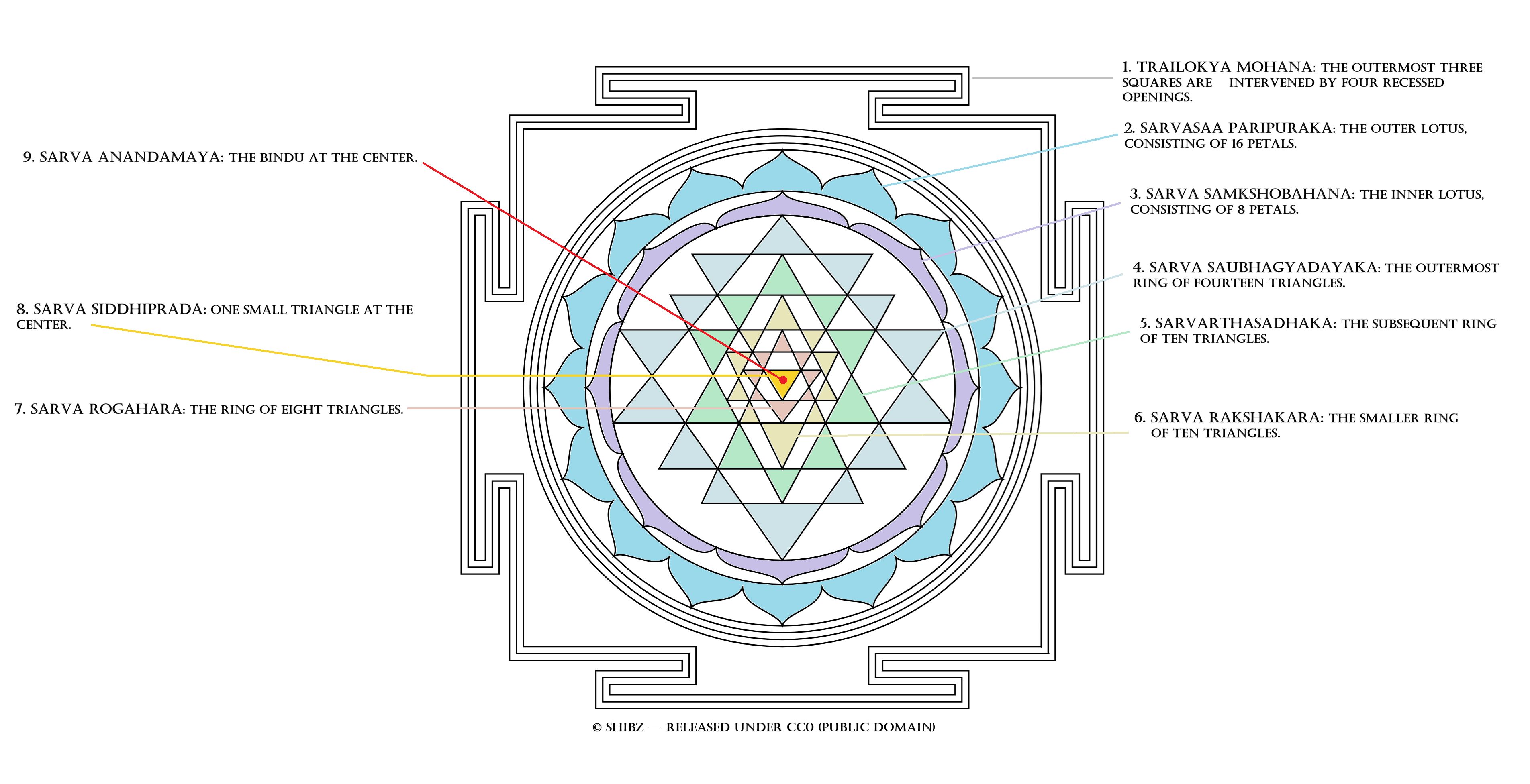
The Nine Āvaraṇas and Their Presiding Deities
1. Trailokya Mohana — Enchanter of the Three Worlds
Presiding Deity Tripurā
This outermost enclosure consists of three concentric lines:
Siddhi Devīs (10):
Siddhis explained
- Anima: The ability to reduce one's body to the size of an atom or the smallest imaginable size.
- Laghima: The power to become almost weightless or lighter than air, allowing for levitation.
- Mahima: The ability to expand one's body to an infinitely large size.
- Prapti: The ability to access or achieve any place or object desired (unrestricted access).
- Prakamya: The power to achieve whatever one desires or the ability to stay underwater/hidden.
- Ishatva (Ishvitva): Attainment of absolute lordship or divine power over nature.
- Vashitva: The power to tame, control, or subjugate elements or people.
- Sarvakama / Kamavasayita: The power to fulfill all desires, or the capacity to command the elements to fulfill any wish.
- Ichha: Associated with Iccha-mṛtyu, the power to choose one's own time of death.
- Bhukti: Often refers to enjoyment or worldly enjoyment, which is sometimes listed alongside the power of Mukti (liberation), or implies the ability to enjoy all luxuries without attachment.
- Garima: The power to become infinitely heavy or dense [Not in the list of devis here, but included for completeness]
These siddhis are described as being granted to Lord Hanuman and are also discussed in Patanjali's Yoga Sutras and the Bhagavata Purana.
Mātṛkā Devīs (8):
Mudrā Śaktis (10):
2. Sarvāśā Paripūraka — Fulfiller of All Desires
Presiding Deity Tripureśī Depicted holding a rosary and scripture
Gupta Yoginīs (16):
3. Sarva Saṁkṣobhaṇa — Agitator of All
Presiding Deity Tripura Sundarī Shown with Abhaya and Varada mudrās
Guptatara Yoginīs (8):
4. Sarva Saubhāgyadāyaka — Bestower of Auspiciousness
Presiding Deity Tripura Vāsinī
Sampradāya Yoginīs (14):
5. Sarvārthasādhaka — Accomplisher of All Purposes
Presiding Deity Tripurasrī Depicted holding a noose, goad, skull, and blessing gesture
Kula / Kulotteerna Yoginīs (10):
6. Sarva Rakṣākara — Protector of All
Presiding Deity Tripura Mālinī
Nigarbha Yoginīs (10):
7. Sarva Rogahara — Remover of All Disease
Presiding Deity Tripura Siddhāmbā
Revered as the destroyer of poison and affliction
Rahasya Yoginīs (8):
8. Sarva Siddhiprada — Granter of All Siddhis
Presiding Deity Tripurāmbā
Depicted with a rosary and boon-bestowing gesture
Atirahasya Yoginīs (3): Kameshvari (Parvati), Vajreshi (Lakshmi/Parvati), Bhagamalini (Saraswati)
9. Sarvānandamaya — Embodiment of Supreme Bliss
Presiding Deity Śrī Rājarājeśvarī (Mahātripurasundarī)
The Bindu, representing ultimate unity and bliss
Spiritual Insight
The Śrī Chakra is not merely symbolic — it serves as a path of inward realization. Each āvaraṇa represents a refinement of awareness, guiding the practitioner from outer multiplicity toward inner unity.
Through contemplation, recitation, and devotion, one moves progressively toward the Bindu, where all distinctions dissolve and the seeker experiences the fullness of Ānanda (divine bliss).